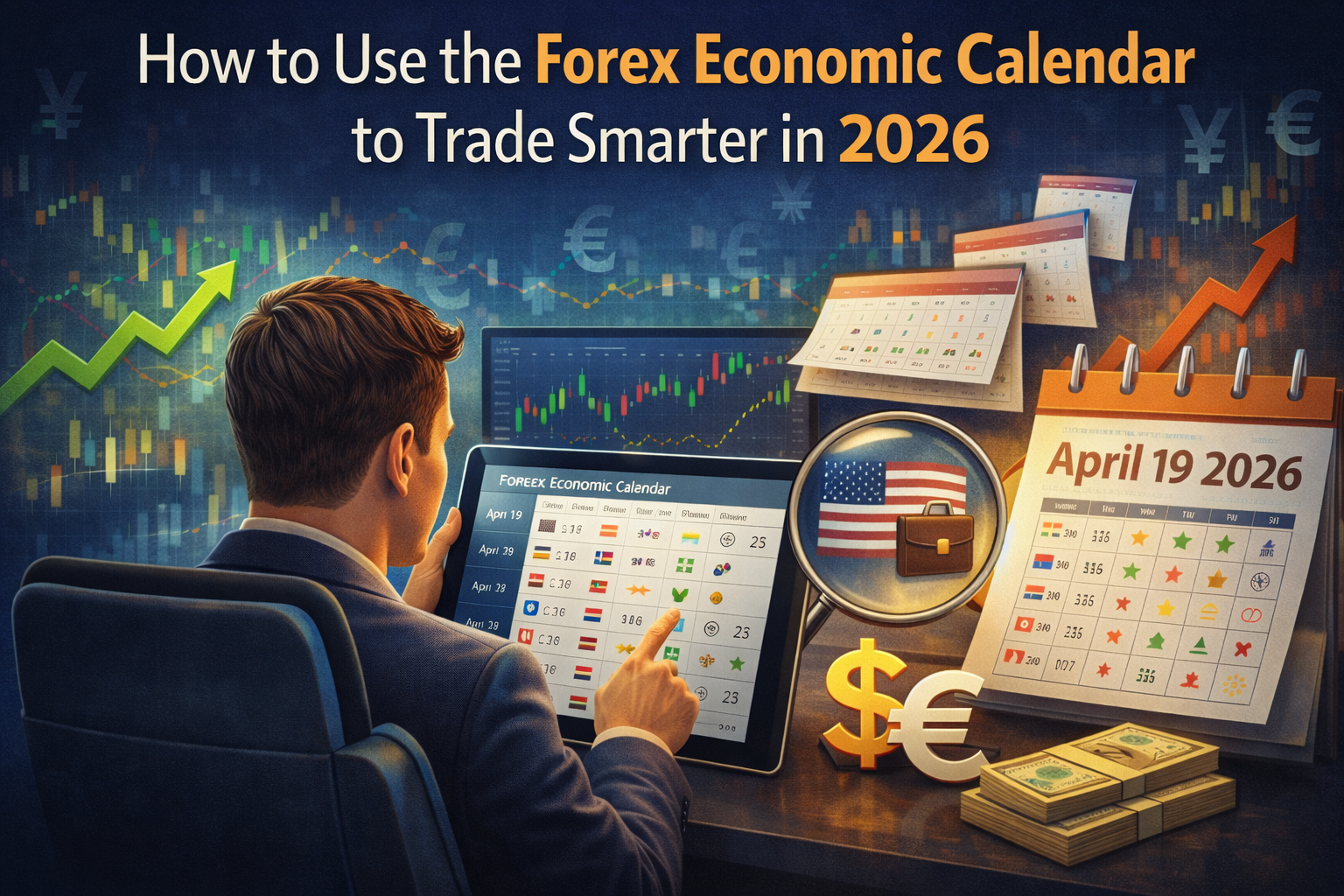
Every experienced Forex trader will tell you the same thing: the market doesn’t move randomly. Behind every major price spike, every sudden reversal, every gap at the open — there’s almost always a piece of economic data pulling the strings. And the one tool that tells you exactly when that data is coming? The economic calendar.
If you’re not building your trading week around it, you’re already behind.
This guide covers everything — from what the economic calendar actually is and how to read it properly, to which events you need to circle in red, real-world examples pulled from live calendar data, and how to construct a disciplined strategy around scheduled news releases.
What Is the Forex Economic Calendar and Why Should You Care?
At its simplest, the Forex economic calendar is a forward-looking schedule of every major economic event, data release, and central bank announcement that has the potential to move currency markets. It shows you the date, the time, the country and currency affected, what the event is, and — critically — the difference between what economists expected and what actually happened.
That last part is where the money is made and lost.
Currency prices are essentially a real-time vote on the health of an economy. When a country’s economic data comes in stronger than expected, its currency tends to strengthen. When data disappoints, the currency typically falls. The economic calendar is the roadmap that tells you when these votes are being cast.
Ignore it, and you’ll find yourself holding a position that gets obliterated by a data release you didn’t even know was coming. Study it, and you’ll start approaching each trading session with a level of preparation that puts you firmly in control.
Breaking Down the Economic Calendar: What Each Column Means
Whether you’re using Myfxbook, Forex Factory, Investing.com, or any other platform, every economic calendar shares the same core structure. Here’s exactly what to look at:
Date and Time
Events are listed chronologically, down to the minute. This is non-negotiable information. A release at 13:30 UTC behaves very differently to one at 23:45 — the former hits during peak London/New York overlap (maximum liquidity), while the latter lands in the thin Asian session (potential for exaggerated moves on lower volume).
Always convert to your local timezone before the trading week begins. Missing a release by 10 minutes because of a timezone error is an avoidable mistake.
Currency
This tells you which currency — and therefore which pairs — will be directly affected. A Canadian inflation release tagged CAD will move USD/CAD, CAD/JPY, EUR/CAD, and GBP/CAD. An ECB announcement tagged EUR ripples across EUR/USD, EUR/GBP, EUR/JPY, and the entire Euro complex.
Impact Rating
Calendars colour-code events by their expected influence on the market: Low, Medium, and High. High-impact events are the ones that routinely shift markets by 50 to 200+ pips in seconds. Medium-impact events can surprise. Low-impact events are generally background noise — unless the actual number is wildly off from expectations.
The Three Numbers That Matter Most
This is where most beginner traders stop paying attention — and it’s exactly where they should be paying the most.
| Column | What It Tells You |
| Previous | The last official reading for this indicator |
| Consensus / Forecast | The market’s expectation, based on economist surveys |
| Actual | The real figure when it’s released |
Here’s the key insight: markets price in the forecast before the release. If everyone expects US Retail Sales to grow 0.8% month-on-month and the actual comes in at 0.8%, the reaction is often muted — it’s already in the price. But if the actual prints at 1.3%? That’s a genuine surprise, and the market reprices aggressively.
The trade isn’t in the number itself. It’s in the deviation from expectation.
The Events That Actually Move Forex Markets
Hundreds of events appear on the economic calendar every week. Most of them are noise. A small handful are genuine market movers. Here’s your definitive guide to the ones that matter.
Non-Farm Payrolls — The Monthly Earthquake
Released on the first Friday of every month at 13:30 UTC, the US Non-Farm Payrolls report is arguably the single most anticipated event on the entire Forex calendar. It measures how many jobs were added (or lost) in the US economy outside of the agricultural sector — and the market reacts violently to surprises.
A typical NFP release can move EUR/USD by 80 to 150 pips within the first 60 seconds. The headline number matters, but so does the unemployment rate and the average hourly earnings figure that accompanies it. Strong wage growth signals inflation pressure, which feeds directly into Federal Reserve rate expectations.
📎 Follow NFP releases at the US Bureau of Labor Statistics
Central Bank Interest Rate Decisions
Nothing moves currencies more consistently than interest rate decisions. The Federal Reserve, European Central Bank, Bank of England, Bank of Japan, and Bank of Canada all meet on scheduled dates throughout the year to set their benchmark rates. The decision itself is important — but so is the statement that follows and, if applicable, the press conference.
Traders don’t just react to what a central bank does. They react to what it signals it might do next. A rate hold accompanied by hawkish language (hints at future hikes) can be just as bullish for a currency as an actual rate increase.
📎 Federal Reserve meeting schedule: federalreserve.gov
Inflation Data — CPI and Its Variants
Consumer Price Index (CPI) releases are now among the highest-impact events on any economic calendar, following years in which inflation dominated global monetary policy. When inflation runs hot, central banks raise rates. When it cools, they cut. Currency traders follow this logic obsessively.
For example, looking at real calendar data: on 20 April 2026, Canada releases six separate inflation metrics simultaneously at 13:30 UTC — including CPI Common YoY (previous 2.4%, consensus 2.9%), CPI Trimmed-Mean YoY, and the headline Inflation Rate YoY. Every single one is flagged as High impact. On a day like that, USD/CAD is essentially a live referendum on Bank of Canada rate expectations.
Similarly, the UK releases its March CPI figures on 22 April 2026 — headline Inflation Rate YoY sitting at 3.0% previously, with a consensus of 3.3%. The GBP will react sharply in either direction depending on whether the actual figure beats, meets, or misses that forecast.
Employment Data Beyond NFP
It’s not just the US that produces market-moving employment numbers. The UK’s monthly employment release — covering Employment Change, Unemployment Rate, Average Earnings, and Claimant Count — is a significant event for GBP pairs. On 21 April 2026, all of these land at 07:00 UTC simultaneously, with UK Employment Change previously at 84K but the consensus forecasting a drop to -35K. That’s a massive expected deterioration — and the actual figure could move GBP/USD by 100 pips or more.
📎 UK labour market statistics: ons.gov.uk
GDP Growth Rate
Gross Domestic Product is the broadest measure of an economy’s health. Quarterly GDP readings are among the most anticipated releases on the calendar, particularly for the US, UK, and Eurozone. A strong beat confirms economic resilience and supports the currency. A miss raises recession fears and typically triggers a sell-off.
Retail Sales
Consumer spending accounts for the majority of economic activity in most developed nations. Retail Sales data — released monthly — provides one of the clearest real-time reads on whether consumers are confident and spending. On 21 April 2026, US Retail Sales figures hit at 13:30 UTC across multiple metrics (MoM, YoY, ex-Autos, ex-Gas/Autos), all rated High impact. That release alone is capable of setting the tone for USD pairs for the remainder of the day.
Business and Consumer Confidence Surveys
Forward-looking surveys like the German ZEW Economic Sentiment, the US Michigan Consumer Sentiment, and Germany’s Ifo Business Climate are watched closely because they signal where economic conditions are heading — not just where they’ve been. On 21 April 2026, the German ZEW Economic Sentiment is forecast to drop from -0.5 to -10, a sharp deterioration that could weigh on EUR. The Ifo Business Climate follows on 24 April, offering another data point on Eurozone health.
Central Bank Speeches
Don’t overlook scheduled speeches from central bank officials — they regularly appear on the economic calendar and can move markets almost as much as rate decisions. The week of 19–25 April 2026 alone features ECB President Lagarde speeches on both Monday and Wednesday, plus remarks from ECB’s Guindos, Lane, Elderson, Cipollone, and Donnery. Each one carries the potential to shift EUR expectations.
📎 ECB speeches and publications: ecb.europa.eu
A Real Trading Week Through the Economic Calendar Lens
Theory is one thing. Let’s walk through a genuine trading week — 19 to 25 April 2026 — to show how a prepared trader thinks about their week in advance.
Sunday night: Check the NZD Balance of Trade release coming at 23:45 UTC. Previous reading was -NZ$0.257B (deficit), but the consensus calls for a swing to +NZ$0.27B (surplus). That’s a dramatic reversal. NZD/USD and NZD/JPY deserve attention at the Asian open.
Monday 20 April: Canada dominates. Six inflation metrics at 13:30 UTC — all High or Medium impact. The day belongs to USD/CAD. The afternoon ECB Lagarde speech at 17:40 UTC adds a EUR wildcard. The pre-London session is relatively quiet, but don’t get comfortable.
Tuesday 21 April: The busiest day of the week. UK employment at 07:00, German ZEW at 10:00, and US Retail Sales at 13:30 — three separate high-impact clusters across three different currencies. This is a day for reduced position sizes and heightened awareness. Triple-volatility sessions can whipsaw even well-placed trades.
Wednesday 22 April: UK CPI at 07:00 is the headline event — GBP pairs are in play. Multiple ECB speeches follow. EIA oil inventories at 15:30 may affect CAD and commodity-linked pairs indirectly.
Thursday 23 April: US Initial Jobless Claims, Continuing Claims, and the 4-Week Average all land at 13:30 — all flagged High. Weekly claims have become a major data point given the Fed’s sensitivity to labour market conditions. Canadian manufacturing and PPI data also hit on Thursday.
Friday 24 April: A strong finish to a heavy week. Japan CPI at 00:30 (High), UK Retail Sales at 07:00 (High), German Ifo at 09:00 (High), and US Michigan Consumer Sentiment at 15:00 (High). Four high-impact releases across four separate currency regions — Friday deserves as much respect as any other day this week.
A trader who maps this out on Sunday is operating in a completely different league to one who wakes up each morning without a plan.
How to Build a Strategy Around Economic Calendar Events
Step 1: Filter by Impact and Relevance
At the start of each week, filter your calendar to show only High and Medium impact events for the currency pairs you actually trade. If you trade EUR/USD and GBP/USD, your week revolves around USD, EUR, and GBP events. You don’t need to track every NZD auction result.
Step 2: Mark Your Risk Windows
For every High-impact event, mark a 30-minute window around it — 15 minutes before and 15 minutes after. During this window, spreads widen, liquidity thins just before the release, and price action becomes less predictable. This is not the time to be entering new trades based on technical setups.
Step 3: Understand the Setup Before the Release
Going into a major release, ask yourself: what does the market expect, and what has it already priced in? If USD has been rallying for a week ahead of NFP on expectations of a strong number, a strong number might produce a “buy the rumour, sell the fact” reversal. Context matters enormously.
Step 4: Have a Plan for Each Scenario
Before a major event, know your response to three outcomes: better than expected, in line with expectations, and worse than expected. What does each scenario mean for the currency? What level would confirm a tradeable breakout? What would invalidate your bias?
Step 5: Manage Risk Aggressively Around Releases
If you’re already in a trade heading into a High-impact event, consider your options: take partial profit, tighten your stop, reduce your size, or close entirely and re-enter after the dust settles. The potential for a 100-pip spike in either direction in seconds is not a theoretical risk — it happens regularly.
Best Free Economic Calendar Resources
- 📎 Myfxbook Economic Calendar — real-time updates, sentiment overlays, historical data
- 📎 Forex Factory Calendar — colour-coded impact system, community commentary
- 📎 Investing.com Economic Calendar — broad coverage, customisable filters, mobile app
- 📎 DailyFX Economic Calendar — paired with market analysis from experienced traders
- 📎 Trading Economics — excellent historical data and global macro context
Automated Trading and the Economic Calendar
For traders running Expert Advisors (EAs) or algorithmic systems, the economic calendar introduces a specific challenge: automated systems don’t instinctively know when a data bomb is about to drop. A well-tuned EA grinding out consistent pips on technical signals can give it all back — and then some — in a single 90-second window around a surprise CPI print.
This is why the best Forex bots and EAs include a dedicated news filter — a mechanism that detects upcoming High-impact events from an integrated calendar feed and automatically suspends trading in the window around them. When evaluating any automated system, this is a non-negotiable feature to look for.
Three Mistakes That Cost Traders Money on News Days
Trading the headline without reading the revision. Economic data is frequently revised in subsequent releases. A previously strong jobs number that gets revised sharply lower can be just as bearish as a weak current print — and traders who miss the footnote get caught wrong-footed.
Assuming direction from the data alone. A rising CPI isn’t automatically bullish for the currency. If the market expected a bigger rise and got a smaller one, the currency might actually fall even as inflation increases. Always compare actual to consensus, not actual to zero.
Going maximum size into volatility. High-impact events dramatically increase the unpredictability of short-term price action. Spreads widen, slippage increases, and even a correctly-called direction can be stopped out by an initial spike before the market settles. Smaller position sizing on news days is not cowardice — it’s professionalism.
Final Word: The Calendar Is Your Trading Week’s Foundation
The Forex economic calendar isn’t a nice-to-have. It’s the backbone of any structured, professional approach to currency trading. It tells you when the biggest opportunities are likely to appear, when to tighten your risk, and when to stand completely aside.
The most successful traders — manual and automated alike — treat the economic calendar the way a pilot treats a pre-flight checklist. It’s not optional. It’s not something you skim on the morning of. It’s the framework that everything else is built around.
Start there. Build your week around the data. Respect the releases. Trade with a plan.
🚀 Trade EUR/USD and GBP/USD With a Smarter Edge
Now that you understand how economic events drive currency markets, imagine having an automated system that’s built specifically to trade the two most liquid, most news-sensitive pairs in the world — EUR/USD and GBP/USD — with precision, discipline, and built-in risk management.
That’s exactly what Nexus Forex Trading delivers.
Our EUR/USD and GBP/USD EA Bot is engineered to capitalise on the volatility and opportunity these pairs generate week in, week out — with smart filters designed to navigate the kind of economic event-driven market conditions we’ve covered throughout this guide.
🎁 Join today and claim your exclusive 50% discount. Use code NEXUS50FX at checkout — and start trading with a real edge.
👉 Get Started with Nexus Forex Trading →

Risk Disclaimer: Forex and CFD trading involves a significant level of risk and may not be suitable for all investors. Past performance is not a reliable indicator of future results. Always ensure you fully understand the risks involved and seek independent advice if necessary. This article is intended for educational purposes only and does not constitute financial advice.